Monday, 16 December 2019

The British Election of 2019 and a Tribute to Noel Ignatiev


You’re listening to Back in the USSR on CFRU 93.3 FM, I am Siegfried.  Last Thursday the United Kingdom went to the polls in one of the most pivotal national elections in a generation.  The British Labour Party under Jeremy Corbyn, a long-time progressive and anti-imperialist, with a history of solidarity with the Palestinian people in particular, faced off against incumbent Prime Minister Boris Johnson’s Conservatives, who have presided over one of the most brutal austerity regimes in the world – cutting back on every kind of social spending and consigning millions upon millions of people to poverty and homelessness while giving every subsidy and tax break one can think of to the one percent.  Unfortunately that hyper-capitalist regime of austerity was given a major boost last Thursday, with the Conservatives winning an absolute majority in the UK parliament.  A moment of truth and a moment of shame, and a moment that will cost the lives of many people, too many people, over the course of the next five years as the Tories move forward with, amongst other things, their now exposed plan to privatize the UK’s public healthcare system, the NHS, thereby handing fat profits to US multi-national pharma and health insurance companies that profit off of the pain and suffering of sick people.

Jeremy Corbyn, with his explicit rejection of capitalist austerity and calls for a government that would put the needs of people first, represented a genuine hope for many people.  Myself included.  Even though he’s no Marxist, his policies would have provided relief to so many suffering people and saved a lot of lives.  His condemnation of Saudi Arabia’s war on the people of Yemen, and his vow to cut off UK arms sales to Saudi Arabia, would have likewise saved countless lives.  While his support for Palestine, Venezuela and Bolivia in the face of brutal US sanctions and Israeli Apartheid might have done something to alter international politics for the better.  And that’s why so many rightwing forces were lining up to silence him and those who supported him, because to them he represented a threat that had to be destroyed.

Moderate Rebels Podcast - The UK Election and Brexit Backlash

Noam Chomsky, himself Jewish, was right to point out how ironic it was that perhaps the strongest anti-racist in the British House of Commons should be presented as a rabid anti-semite by the mainstream media in a country where the far-right has been running rampant for years now.  Yet, as the journalist Asa Winstanley pointed out in a recent article for the Electronic Intifada, the right-wing media campaign to smear Jeremy Corbyn as anti-semitic, which has basically been ongoing since he won the leadership of the Labour Party in 2015, was a major factor in his defeat in the December 12 election.  There was never any credible evidence behind the smears, but a lie endlessly repeated can still be effective, especially when it’s repeated by the mainstream capitalist media for years at a time.  As the independent journalist Max Blumenthal pointed out in a recent article in The Grayzone, one of the main problems that the rightwing has with Corbyn is that he supports Palestinian rights and opposes Israeli Apartheid, and, just as the state of Israel has been trying to do to supporters to Palestinian rights all over the world, he was smeared as an “anti-semite” on that basis. 

Now here it’s worth pointing out that those who support an independent Palestine and self-determination for the colonized Palestinian people, are not the ones shooting up synagogues in Pittsburgh or smashing and defacing Jewish graves in France.  Far-right white supremacists are the ones doing those things.  But neither the Apartheid state of Israel, even though it claims to speak on behalf of the Jewish people, nor any of the capitalist states of Europe or North America care about that.  They’re not interested in stopping the real racists, the real anti-semites, or the real Nazis.  They’re interested in shutting down support for Palestine because that support conflicts with their own geo-political goals, especially when that support comes from the leader of a major political party in a major Western country who has a serious shot at becoming Prime Minister.  This is why there’s been a concerted effort in recent years, both in Europe and North America, to equate criticism of Israeli government policy with anti-semitism and racism toward the Jewish people and religion.  Trump is pushing legislation to this effect in the US, both France and Germany (and now the UK) have passed laws this year which effectively criminalize solidarity with the Palestinians.  And this is music to the far-right’s ears because it effectively gives them a pass.  Most far-right political parties in Europe and America have zero problem with Israel.  In fact they’d like all Jews to move there, which is the effectively same thing that the Apartheid government in Tel Aviv wants in order to shift the demographic balance against the Palestinian majority.  The Israeli government has no problem with far-right racist governments in places like Hungary or Italy, and it has no problem giving guns to Neo-Nazi militia units in Ukraine as I’ve pointed out on a previous episode of the show.  And so the meaning of anti-semitism has been trivialized to the point where it has become nothing more than a political weapon to be used against pro-Palestinian activists and progressive challengers to the status quo, which is exactly what the far-right wants.  I mean instead of hunting Nazis like it used to, the Simon Wiesenthal Center now targets Palestinian activists on behalf of Apartheid Israel.  And Jeremy Corbyn was one of those people targeted for his non-existent anti-semitism, while all over Europe fascist forces are growing stronger and becoming more and more brazen in their violence.  Max Blumenthal, a progressive American Jew, was right to complain about Israel trying to “weaponize” him and other progressive Jews against those it views as political opponents, while giving the real far-right anti-semites a free pass – just as it gives a free pass to a racist conservative British Government that routinely demonizes Muslims, Roma, and migrants of all kinds.

Britain and Europe are really at a crossroads now.  This right-wing victory in the British elections will embolden fascism and rapacious capitalist elites alike.  Resistance is going to be the only choice for millions of people whose lives and livelihoods will be on the line as a new round of austerity begins and the cuts start coming hard and fast.  And that resistance is there and growing.  Particularly at the periphery of the UK.  In the colonized north of Ireland, in one of the few bright spots in the election, the people voted in more pro-Irish nationalist MPs than pro-British unionist MPs for the first time since the partition of Ireland in the 1920s.  Ridings that had remained staunchly loyalist for more than one hundred years changed sides, their inhabitants fed up with poverty, joblessness and cutbacks.  As the issue of Brexit continues to polarize the country, and as a hard and militarized border between the Republic of Ireland and the occupied north looks increasingly likely, both Scotland and the north of Ireland are increasingly looking to break away from the UK and forge their own path.  As a Marxist-Leninist of Irish descent who has long supported Irish independence and opposed colonialism all around the world, I believe that will be a great day for humanity.  Because it will mean the final end of the British Empire and the sun will finally set on centuries of imperial bloodshed and colonial dominion.  And I know many in the Irish Communist Party and the James Connolly Youth Movement who sense that the day of liberation, foretold by Bobby Sands and so many others who gave their lives for a free Ireland, is finally coming after eight hundred years.  Resistance always begins with the colonized.  They are always in the vanguard.  And that’s the way it is in the so-called British Isles right now.  And from the periphery that resistance will spread to the core.  I very much doubt that Boris Johnson will be getting much sleep at any time in the next five years.

And just for those who would accuse me of treason for saying such things; people who would attack me for welcoming Irish independence and the breakup of the UK when many of my own ancestors were English and even fought for the British Empire in its wars.  Some of them might even acknowledge that my Irish ancestors were deliberately starved to death in a genocidal campaign by the British in the 1840s and forced to flee their ancestral land, but still accuse me of hypocrisy because of my family ties to England.  To them I would say this: my granddad grew up in a coal mining town on the Scottish border with no electricity or running water, had his first language taken from him as a kid by a school system meant to turn out obedient workers, saw his fellow miners die around him of tuberculosis and black lung when he was still only a teenager, and yet the British Government still expected him to be willing to die in World War II so that the Empire could hold onto its colony in Burma.  They demanded that my great-uncle do the same thing in Malaysia, and he spent most of the war in a Japanese POW camp as a result.  Like so many other working class kids, they were expected to lay down their young lives for a colonial empire that had used and abused them since they were born.  The only reprieve they got came after the war when the British welfare state and the NHS were constructed, which made life livable for so many English proletarians,
and that was only because the British elite were literally afraid of a socialist revolution breaking out if they didn’t do something for the people .  It’s true that neither of them survived to see this recent election, but they lived long enough to see the onset of austerity and what a hyper-capitalist British Government did to the rights of pensioners.  Now, just like in their days in the coal mines, people like them were expected to die in the name of “efficiency”, unable to access the services that they needed in old age.  So pardon me for saying that neither myself, nor anybody else in my family, owes the British Empire a goddamn thing.  These old soldiers ain’t marching anymore, and their grandchildren are only going to march in picket lines and in the protests and demonstrations that will finally bring this inhuman system to its knees.  My English and Irish ancestors alike will be there on that day.  On that day, both the living and the dead shall celebrate.

Damien Dempsey – Sam Jenkins

Billy Bragg - All You Fascists


So that’s my take on the British election.  The rest of tonight’s show is going to be a little different.  I had the opportunity recently to re-unite with an old comrade of mine and a valued contributor to the show, Brendan Campisi, who some of you might remember from the various times he’s joined me here to talk about different subjects.  I had the privilege of talking to him again earlier today and we discussed the life and legacy of a man that many of you might never have heard of, even though his contribution to a more radical understanding of history is significant indeed.  Noel Ignatiev was an American author and historian, who is best known for his work on race and social class and for his call to abolish “whiteness”.  He was the co-founder of the New Abolitionist Society and co-editor of the journal Race Traitor, which argued that “treason to whiteness is loyalty to humanity”.  Particularly known for the controversial work “How the Irish Became White”.  Born on December 27, 1940 in Philadelphia, Ignatiev was a life-long radical.  At different times he was a member of the Communist Party USA, Students for a Democratic Society, as well as the union movement where he took part in numerous strikes and labor actions.  For twenty years he worked in a Chicago steel mill before being accepted into the Harvard Graduate School of Education in 1985, where he earned his doctorate in 1995.  His PhD dissertation, which later became the book “How the Irish Became White” discussed the integration of Irish immigrants into white supremacist America in the 19th Century, arguing that race is a social construct, not a scientific reality, that groups of people are arbitrarily included in or excluded from by those with political power in society.  Famous for his call to abolish the white race, Ignatiev said this on his website “Race Traitor”:

“We do not hate you or anyone else for the color of her skin. What we hate is a system that confers privileges (and burdens) on people because of their color. It is not fair skin that makes people white; it is fair skin in a certain kind of society, one that attaches social importance to skin color. When we say we want to abolish the white race, we do not mean we want to exterminate people with fair skin. We mean that we want to do away with the social meaning of skin color, thereby abolishing the white race as a social category. Consider this parallel: To be against royalty does not mean wanting to kill the king. It means wanting to do away with crowns, thrones, titles, and the privileges attached to them. In our view, whiteness has a lot in common with royalty: they are both social formations that carry unearned advantages.”

Noel Ignatiev, a Jewish-American who also campaigned hard for Palestinian rights, died on November 9 2019 at the age of 78.  This is the full interview that I did with Brendan Campisi about this remarkable man.

BACK IN THE USSR: THE LIFE AND WORK OF NOEL IGNATIEV

IT'S GOING DOWN: NOEL IGNATIEV ON 'RACE TRAITOR', WHITE SUPREMACY, AND ABOLITION 

Monday, 2 December 2019

The Angel of History


Christy Moore – Allende

You’re listening to Back in the USSR on CFRU 93.3 FM, I am Siegfried and I want to welcome you once again, brothers and sisters, on this late Monday evening.  It’s December now.  2019 is drawing to a close, and even though there’s still a few weeks left to go, I still want to pause and take stock of things tonight, because so much has changed for me over the past two months.  I’m definitely not the same person that I was at the beginning of October.  As so often happens in life, various events and people have combined to break me out of the kind of life I was accustomed to and close the door behind me so that there’s no going back.  It’s a remarkable thing when that happens to you and it almost always sets off a billion conflicting emotions circulating through your head as you try to make sense of a situation you’re not used to and not yet fully comfortable with.  But it’s necessary.  Very necessary. 

And of course I wonder if what I do is ever enough.  Many of my friends and comrades were at the Ontario Federation of Labour (OFL) Convention in Toronto last week and marching on Queen’s Park to challenge Doug Ford’s reactionary agenda, while others were attending Guelph City Council meetings and challenging the council’s atrocious policies with regard to homeless people in this city.  While all I did was knock off a second draft of a novel that may or may not ever see the light of day, whilst drawing up plans for radio shows barely anyone listens to.  I’ve been doing activism for years now, and I’ve seen many good movements rise and fall, all the while trying to find my place; the role in which I can do the most good in these critical times.  It’s not easy.  But I try.  I always try.
So this is going to be more of a personal episode of the show here tonight, definitely more so than last week when I talked about the coup in Bolivia and the week before that when I talked about Remembrance Day and the struggle for world peace.  There’s a lot I need to reflect on, brothers and sisters, so I hope you’ll bear with me.

First, I’d like to read you a quote.  It’s a quote that means a lot to me and that I’ve spoken before on this show, but it’s worth repeating:

“There is a picture by Klee called Angelus Novus.  It shows an angel who seems about to move away from something he stares at.  His eyes are wide, his mouth is open, his wings are spread.  This is how the angel of history must look.  His face is turned toward the past.  Where a chain of events appears before us, he sees one single catastrophe, which keeps piling wreckage upon wreckage and hurls it at his feet.  The angel would like to stay, awaken the dead, and make whole what has been smashed.”

That was the Marxist writer, Walter Benjamin from his Theses on History.  And it is a passage that truly speaks to me.  Because, at the risk of sounding completely ridiculous, I am the Angel of History of which he speaks.  Every day I see the wreckage pile up.  The shattered lives, dreams and whole societies and peoples being bulldozed and broken by the forces of global capitalism.  I see these things.  I read about them.  I listen to them.  I even have an opportunity to take action with regard to them sometimes.  And, on some level, they all become a part of me as I walk this bizarre path that I have chosen in life: a madman who speaks to thin-air from a radio studio, hoping against hope that someone, somewhere, is listening on the other end.

To see what has happened in Bolivia in particular, where an indigenous-led socialist revolution is being torn apart by fascist death squads and military violence, struck me to the core.  And I talked on that episode of the show about my experience of building solidarity for Bolivia back in 2010 when I helped organize that conference at the University of Guelph and how I traveled to Washington in 2015 to stand in solidarity with the victims of Chevron in the Ecuadorian Amazon.  The more you know, the more you experience, the more you fight, the more the dots connect and the more the artificial dividing lines that we erect between past, present and future fall away.  Every struggle has a history.  And to participate in it is to become a part of that history yourself and to understand why it is so vital for working class and oppressed people to emerge victorious in their struggles all over the world, and to unite their struggles into one worldwide struggle against the global capitalist order that continues to grind down people through exploitation and austerity and crush so many people through imperialism and colonialism.  And we remember those who died struggling against capital (or for trying live in ways not determined by capital).  We struggle for justice for those killed in the corporate slaughterhouse (so-called “industrial accidents”).  We struggle for justice for the millions of people killed by imperialist wars, by ongoing colonial genocide, by the so-called “normal” exercises of the free-market that condemn millions to starvation every single year.  We struggle for justice for those who die in police custody.  For those who fell in the struggle against fascism and for the right to unionize, the right to be a woman, the right to be queer, the right to be trans and so on.  They are all part of the same history, the same very bloody history, which animates popular struggles today.
When people fight back against a system built on centuries of oppression and exploitation, it is a struggle for life itself.  The same is true when people stand up against sexism, homophobia or transphobia.  They’re fighting for the right to live.  The right to determine their own destinies.  Self-determination.  Life.

This is the final paragraph of the Song of Ariran, a book written by the Korean revolutionary Kim San (Chang Chi-rak) in 1937 while he was fighting alongside the Chinese Red Army against the Japanese invasion of China:

"Nearly all the friends and comrades of my youth are dead, hundreds of them: nationalist, Christian, anarchist, terrorist, communist. But they are alive to me. Where their graves should be, no one ever cared. On the battlefields and execution grounds, on the streets of city and village, their warm revolutionary blood flowed proudly into the soil of Korea, Manchuria, Siberia, Japan, China. They failed in the immediate thing, but history keeps a fine accounting. A man's name and his brief dream may be buried with his bones, but nothing that he has ever done or failed to do is lost in the final balance of forces. That is his immortality, his glory or shame. Not even he himself can change this objective fact, for he *is* history. Nothing can rob a man of a place in the movement of history. Nothing can grant him escape. His only individual decision is whether to move forward or backward, whether to fight or submit, whether to create value or destroy it, whether to be strong or weak."

Rage Against the Machine – War Within a Breath

Kim San fought for life and he gave his life for his cause.  The same reason why people are fighting in Bolivia and Chile right now.  That’s why people go out into the streets, knowing that they’ll face guns and tear gas, just as their indigenous ancestors faced down the conquistadors and their guns, germs and steel and have continued fighting for the right to live for five hundred years.  This is why they remember the example of Tupac Katari and Salvador Allende and why they still sing the songs of Victor Jara.  The past always matters.  It provides the history, the foundation, on which modern struggles take place.  One of the major factors in my own political radicalization, as well as that of my friend Padraic, who I just visited recently in Ottawa, was the centuries long struggle of the Irish people for liberation.  Both of us come from an Irish background.  Both our families were driven from Ireland by genocidal British imperialism in the 19th Century.  Both our families were re-settled in Canada as part of Britain’s settler-colonial genocide against indigenous people here.  And both of us refuse to play a part in that settler-colonial genocide any longer, instead drawing on our own history, the Irish tradition of anti-colonial struggle, to stand as allies alongside indigenous people as they fight for their lives.

People resisting colonial oppression, from Unis’toten to Palestine know that they do not fight solely for the well-being of their future grandchildren, but for the redemption of oppressed and exploited ancestors as well.  They know that they are part of a tradition of struggle that links the past and the present and the future, and that this is a source of strength as they face their oppressors.  This is what Bobby Seale of the Black Panther Party meant when he said that “we guide our feet by the lamps of the past”.  History is a driving force, informing people who they are, and why they must fight back.  And all the really strong and enduring working class struggles in the 20th and 21st Centuries have likewise understood that they are a part of a tradition of proletarian resistance and struggle that transcends borders, spans the entire world and forms an integral part of who we are.  I mean there’s a reason why I sing the following song whenever I go to visit my friend Padraic up in Ottawa:

The Wolfe Tones – Highland Paddy

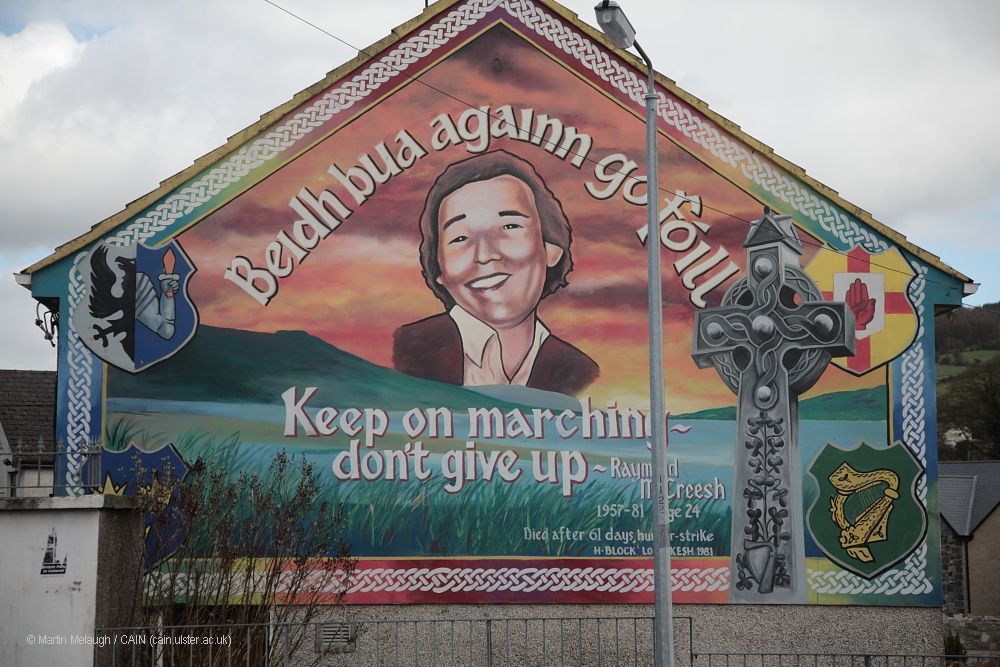
Now, I promised y’all that I’d sing for you again.  And I’ve chosen a much less well known Irish rebel song, paying tribute to a man who, alongside Bobby Sands and eight others, died on hunger strike in Long Kesh Prison in 1981, protesting against the British government’s inhuman treatment of Irish prisoners of war during the Troubles.  Ray McCreesh of South Armagh was one of those who gave his life for the liberation of his people, dying May 21st 1981 after 61 days on hunger strike, and this song is for him.

I remember from my boyhood,
Down in South Armagh,
I’d lie beneath an evening sky and search for shooting stars.
Often would I wonder,
What I would grow to be,
But fate would choose a different course,
My name is Ray McCreesh.
What kind of a system,
Would bring a people to their knees?
Try to break their spirits,
And rob their dignity.
With injustice all around me,
I knew something must be done,
While others learned indifference,
I learned to hold a gun.
Captured and imprisoned,
Thrown in an H-Block cell,
Four years on the blanket protest,
I served my time in hell,
Denied of any status,
They called my cause a crime,
So on a hunger strike I joined,
To prove their words were lies.
As my time was fast approaching,
The Lord took me by the hand,
He said ‘Once more I bear witness to man’s inhumanity to man,’
Another martyr for old Ireland,
Another thorn in my crown,
You’ve done your time upon the cross,
My son I’ll help you down.
If you’re ever up in Camlough,
In my native South Armagh,
And you gaze upon that evening sky,
And see a shooting star.
Just remember that this young boy,
Used to dream his young boy dreams,
Think of me when you whisper prayers,
My name is Ray McCreesh.
Think of me when you whisper prayers,
My name is Ray McCreesh.

Cara McCann - Song for Marcella

That was “My Name is Ray McCreesh”.  What Che Guevara said remains true: real revolutionaries are motivated by feelings of love.  It was December 2 1956 when Che and 81 other Cuban revolutionaries disembarked from the vessel Granma and began their struggle to overthrow the US-backed dictator Fulgencio Batista.

“We reached solid ground, lost, stumbling along like so many shadows or ghosts marching in response to some obscure psychic impulse. We had been through seven days of constant hunger and sickness during the sea crossing, topped by three still more terrible days on land. Exactly 10 days after our departure from Mexico, during the early morning hours of December 5, following a night-long march interrupted by fainting and frequent rest periods, we reached a spot paradoxically known as Alegría de Pío (Rejoicing of the Pious)”. –Che Guevara

Bombarded by warplanes and attack helicopters, only twenty of the original eighty-two men who landed on that beach made it to the mountains to carry on the fight.  No one could have expected at the time that on January 1 1959, the Cuban Revolution, led by Fidel Castro, would triumph and light a flame that continues to burn to this day.

Christy Moore - Companeros

After the Nazis invaded the Soviet Union in June 1941, another revolutionary showed her true colors.  Nadya Popova, after an aggressive campaign to get the Soviet government to allow women to serve in the Red Air Force, became the commander of the 2nd Women’s Regiment, which did not include a single male in its ranks.

“The Germans knew all about us.  They called us ‘night witches’.  In fact the Germans spread stories that we were given special injections and pills which gave us a feline’s perfect vision at night.  This was nonsense, of course.  What we did have were clever, educated, very talented girls.  All were volunteers.”

Using nothing more than old PO-2 two-seater open cockpit bi-planes, made of plywood and canvas, the “night witches” would approach their targets at perilously low altitudes, at night, sometimes passing through “a wall of enemy fire while the Germans tried to blind us with their searchlights”.  Pilots would sometimes fly between fifteen and eighteen sorties per night, sometimes cutting their engines and gliding silently over the trees to drop bombs on unsuspecting enemy encampments.
“The Germans called us ‘night witches’,” said Popova. “Yes, we practiced our ‘witchcraft’ almost from the first to the last days of the war.” (from Albert Axell, "Russia's Heroes 1941-1945: True Stories of the Soviet Patriots who Defied Hitler")

Power Symphony – Way of the Sword

Everyone has their particular part to play in the struggle, as Bobby Sands used to say.  Brothers and sisters, never stop caring, loving, fighting.  Even on those days when life feels like a mountain on your back.  Somedays living is the only victory that can be won.  But we need you.  The people need you.  And just as we make our stand today, we must remember that we are a part of history, alongside all the generations before us “who struggled against all odds with all the fear and courage of ordinary humans, whose names we shall never know, whose blood and tears we shall never see, whose cries of pain and hope we shall never hear, to them we are linked by a past that is never dead nor ever really past.  And so, when the best pages of history are finally written, it will be not by princes, presidents, prime ministers, or pundits, nor even by professors, but by the people themselves.  For all their faults and shortcomings, the people are all we have.  Indeed, we are they (from Michael Parenti, The Assassination of Julius Caesar: A People’s History of Ancient Rome).”

Fannon – Poet Throw Down

Declan O’Rourke – Time Machine